I am keen to try different printing processes so I enrolled for a reduction lino workshop last weekend with Mary Gillett. I am also doing a weekly etching course with Mary and enjoy working in her large studio out in the country near Tavistock in Devon. There was only 3 of us so we got lots of individual attention and a printing press each! The weather was glorious and we were able to keep our lino very warm and supple under the sun as well as enjoy lunch outside!!
The lino reduction method was invented by Picasso, who had a great love of printmaking apparently. This method of lino cutting involves progressively cutting the same linoblock for each new colour, making it impossible to take any further prints from the original plates, and there’s not much left of them anyway!
Mary suggested we made 10 prints– that number would allow for mistakes and hopefully we would get a few good ones - so it is quite time consuming, printing each colour 10 times. The registration for printing is really important and we spent a lot of time getting it right so that each print would line up exactly on the press – even so I managed to get some of mine slightly out which of course shifts everything – sometimes this works sometimes it doesn’t – such is the excitement of printing – you never know what you are going to get!!
I worked from a coloured drawing prepared earlier (yes of course I watched Blue Peter!) I wanted to capture the gorse on the moor near my house and took my sketchbook on my walks last week – this was the drawing that I worked from
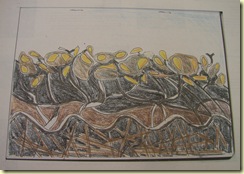
I then made a tracing of the drawing, reversed it and traced it through carbon paper onto the lino. I was then ready to make the first cuts and remove the areas that I wanted white. The vivid yellow of the gorse was the most important colour to keep pure so that was the first colour I printed

I then cut away the areas I wanted yellow. It was quite strange at first cutting away the area of the wanted colour, a reversal of the usual practice of taking away what you don’t want! The next colour was blue – I loved rolling out the colours on to plate glass before applying it to the linocut.

this is the stage when you know whether the registration is correct. I had forgotten one of the instructions, to always run the print through the press in the same direction and as a result some of my prints were a fraction out! All good learning - but it pays to listen!!

It is usual practice to work from light to dark but other considerations are important as you are overlaying colours on top of each other and they are still wet unless you take a week and do one colour a day!
I then cut away the blue area, the sky,


and printed in a light grey/brown – I had now printed 30 times and was half way through the second day – I realised I was not going to finish in a weekend !


So at the end of the weekend I was nearly there but still have a couple more colours to apply– another brown and finally black – unless I change my mind and choose other colours after living with them for a couple of weeks – I can’t get back to the studio again until 9 June to complete the prints – I’ll post the finished result then but meantime this is as far as I got…….. x 10!


